Entrectinib (Rxdx-101) Rxdx-101 Trk receptor targeting and cost-effectiveness in ROS1-positive NSCLC
Copy code to add this image to your page
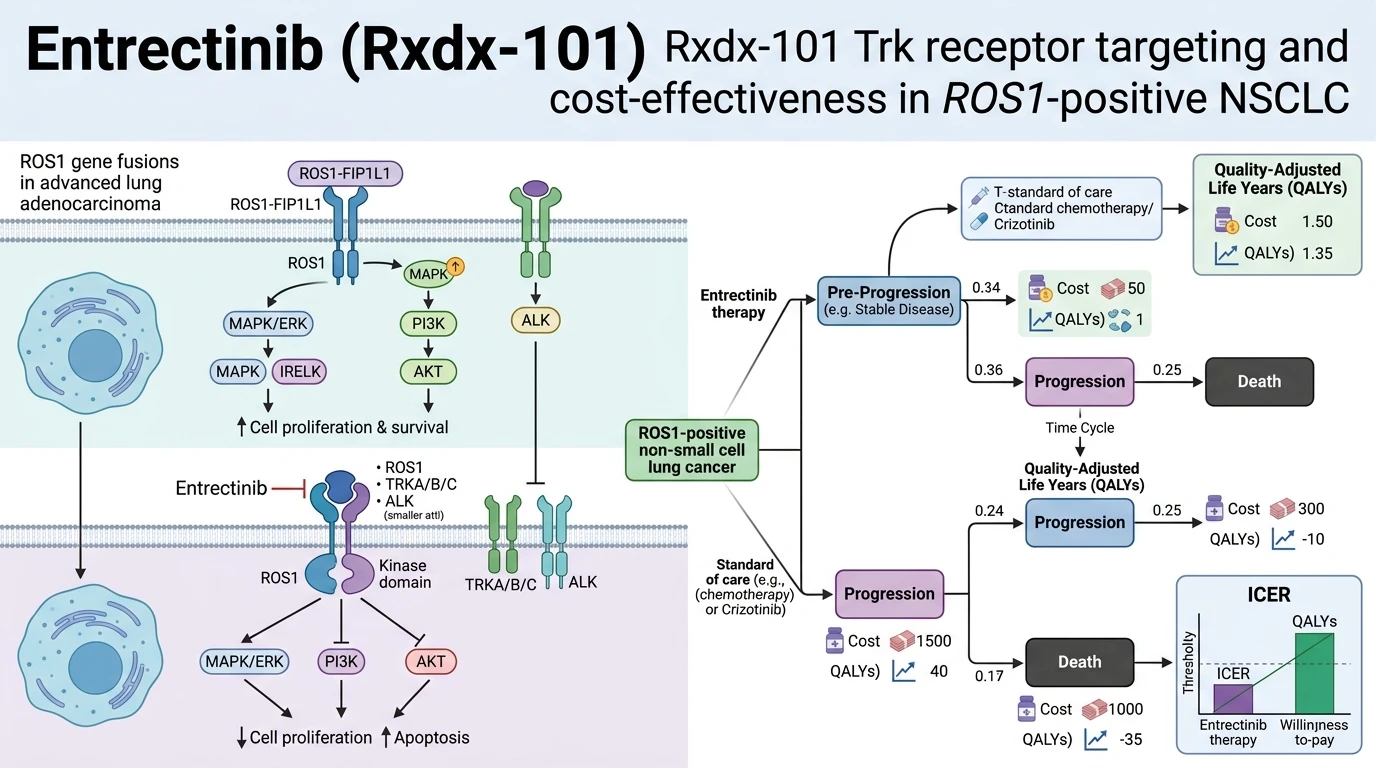
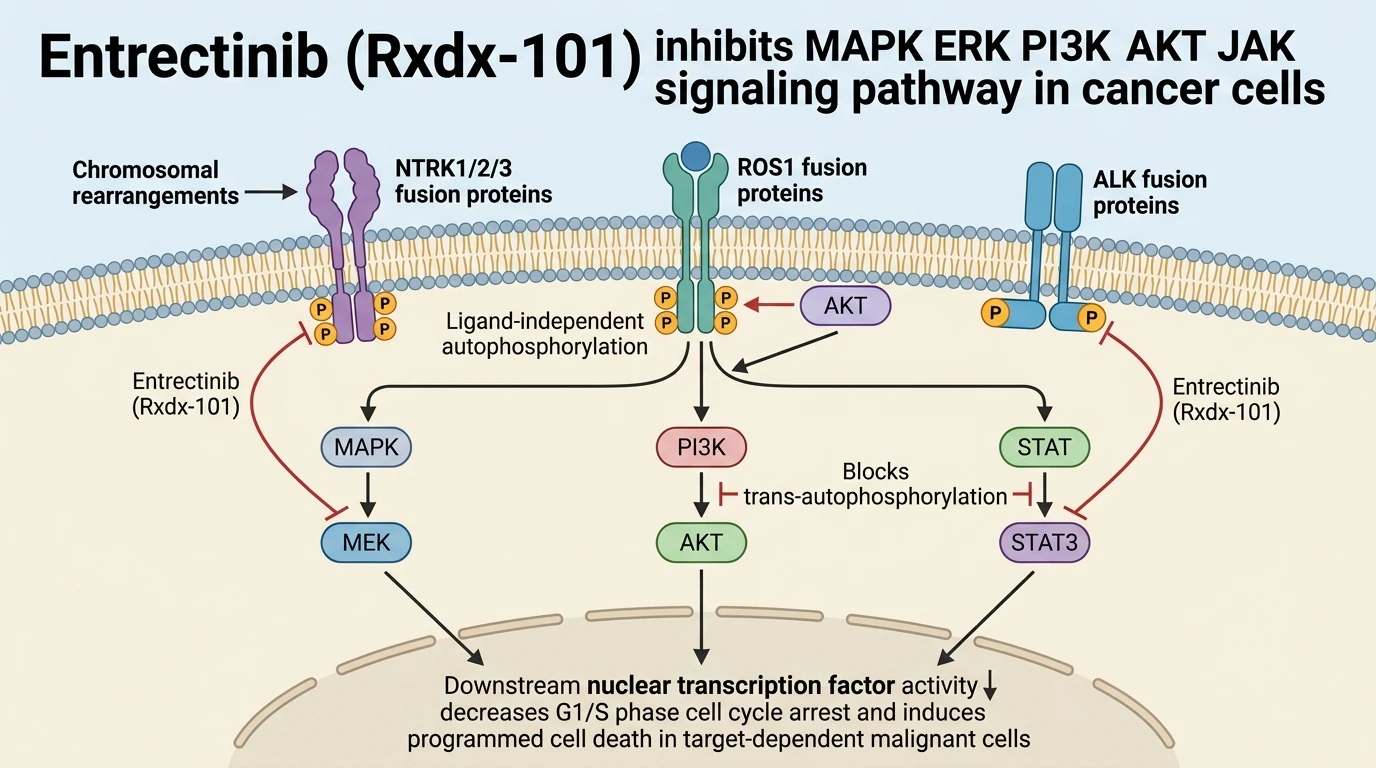
Entrectinib (Rxdx-101) is a small-molecule, ATP-competitive multikinase inhibitor designed with blood-brain barrier penetrance. The molecule targets specific receptor tyrosine kinase fusions involving ROS1, ALK, and the tropomyosin receptor kinase family encoded by NTRK1, NTRK2, and NTRK3. Under baseline physiological conditions, TRK receptors undergo dimerization upon neurotrophin binding, mediating survival, differentiation, and synaptic plasticity across central and peripheral nervous tissue. However, somatic chromosomal translocations fuse the kinase domain of ROS1 or TRK to heterologous gene partners. These structural alterations trigger ligand-independent dimerization, continuous trans-autophosphorylation, and constitutive signal transduction through downstream effector networks. Oncogenic signaling via ROS1 and TRK fusions relies heavily on three primary pathways: the mitogen-activated protein kinase (MAPK)/extracellular signal-regulated kinase (ERK) pathway, the phosphatidylinositol 3-kinase (PI3K)/protein kinase B (AKT) axis, and the signal transducer and activator of transcription 3 (STAT3) pathway. Activation of MEK1/2 and ERK1/2 promotes transcription of genes governing cyclin D1 expression, driving cell cycle entry. Concurrently, AKT activation inhibits pro-apoptotic proteins such as BAD and caspase-9, sustaining cellular viability under nutrient-depleted microenvironments. JAK/STAT signaling further reinforces transcription of anti-apoptotic mechanisms, preventing programmed cell death. Entrectinib occupies the ATP-binding pocket within these catalytic domains, preventing phosphate transfer to tyrosine residues. Downstream cascade activation ceases rapidly following target engagement. In patient-derived cell lines and xenograft models harboring ROS1 or NTRK fusions, entrectinib administration inhibits kinase phosphorylation at nanomolar concentrations, leading to cell cycle arrest and apoptosis. In advanced non-small cell lung cancer (NSCLC), oncogenic ROS1 fusions represent approximately 1% to 2% of diagnoses. While targeted kinase inhibition displays marked systemic and intracranial response rates in clinical trials, the broader health economic viability of integrating small-molecule inhibitors into standard clinical care requires rigorous decision-analytic evaluation. A recent pharmacoeconomic study evaluated the cost-effectiveness of entrectinib as first-line or second-line therapy relative to standard platinum-based chemotherapy in patients with ROS1 fusion-positive advanced NSCLC within the United States. Utilizing a Markov state-transition model based on clinical trial outcomes, the analysis quantified costs and health utility metrics over a lifetime horizon. Primary outcome measures included overall costs, quality-adjusted life years (QALYs), and incremental cost-effectiveness ratios (ICERs) evaluated against a willingness-to-pay threshold of $150,000 per QALY. In the first-line therapeutic setting, entrectinib administration generated a health gain of 0.07 QALYs compared to conventional chemotherapy protocols. However, this gain accrued an incremental expense of $73,453 per treated individual. The resulting ICER reached $1,090,594.30 per QALY gained, exceeding the accepted willingness-to-pay benchmark. Sensitivity analyses demonstrated that high drug procurement costs were the dominant driver of economic outcomes. In the second-line therapeutic scenario, entrectinib yielded an additional 0.11 QALYs over chemotherapy, accompanied by an incremental cost of $53,480. This setting produced an ICER of $494,290.39 per QALY gained. Although second-line application reduced the incremental cost per QALY by more than half relative to first-line deployment, both treatment strategies failed to meet US cost-effectiveness standards at current drug pricing levels. Deterministic parameter variations revealed that substantial discounts on wholesale acquisition costs would be necessary to align entrectinib therapy with conventional cost-effectiveness benchmarks.
Pharmacoeconomic Evaluation and Downstream Kinase Inhibition
Copy code to add this image to your page
Entrectinib (Rxdx-101) is an orally bioavailable, central nervous system-active multikinase inhibitor that selectively targets ROS1, TRKA, TRKB, TRKC, and ALK fusions. By competitively occupying the ATP-binding pocket of these receptor tyrosine kinases, entrectinib blocks trans-autophosphorylation and inhibits constitutive activation of downstream MAPK/ERK, PI3K/AKT, and JAK/STAT cascades. This selective inhibition halts tumor cell proliferation and survival. Pharmacoeconomic modeling indicates that while entrectinib provides quality-adjusted survival benefits in ROS1-positive non-small cell lung cancer, high procurement costs impair cost-effectiveness relative to standard thresholds in both first- and second-line US clinical contexts.
First-Line Entrectinib Yields Substantial Incremental Cost-Effectiveness Ratios
In decision-analytic Markov modeling under US healthcare payer conditions, first-line entrectinib demonstrated modest gain in quality-adjusted life years (QALYs). The administration of entrectinib accrued an additional 0.07 QALYs compared to conventional platinum-based chemotherapy. Total expenditures increased significantly. Incremental drug acquisition costs reached $73,453 per patient. Consequently, the resulting incremental cost-effectiveness ratio (ICER) calculated to $1,090,594.30 per QALY gained. At a standard willingness-to-pay threshold of $150,000 per QALY, first-line intervention failed to achieve cost-effectiveness. High acquisition price served as the principal economic driver. Target affinity across the Rxdx-101 Trk receptor domain remains potent in vitro; however, clinical utility in front-line settings faces economic constraint.
Second-Line Sequencing Provides Favorable Economic Compromise
Second-line application yielded distinct economic parameters within the modeled cohort. Patients receiving second-line entrectinib achieved an incremental gain of 0.11 QALYs over standard chemotherapy protocols. The total incremental cost accumulated to $53,480 per treated individual. This generated an ICER of $494,290.39 per QALY gained. Although this value remains above the $150,000 per QALY willingness-to-pay benchmark, it represents a substantial reduction relative to front-line utilization. Reserving target inhibition for second-line therapy offers a preferable strategic balance. Acquisition cost negotiation could further realign economic feasibility.