Irinotecan Hydrochloride Trihydrate targeting Topoisomerase I in neuroendocrine carcinoma therapy
Copy code to add this image to your page
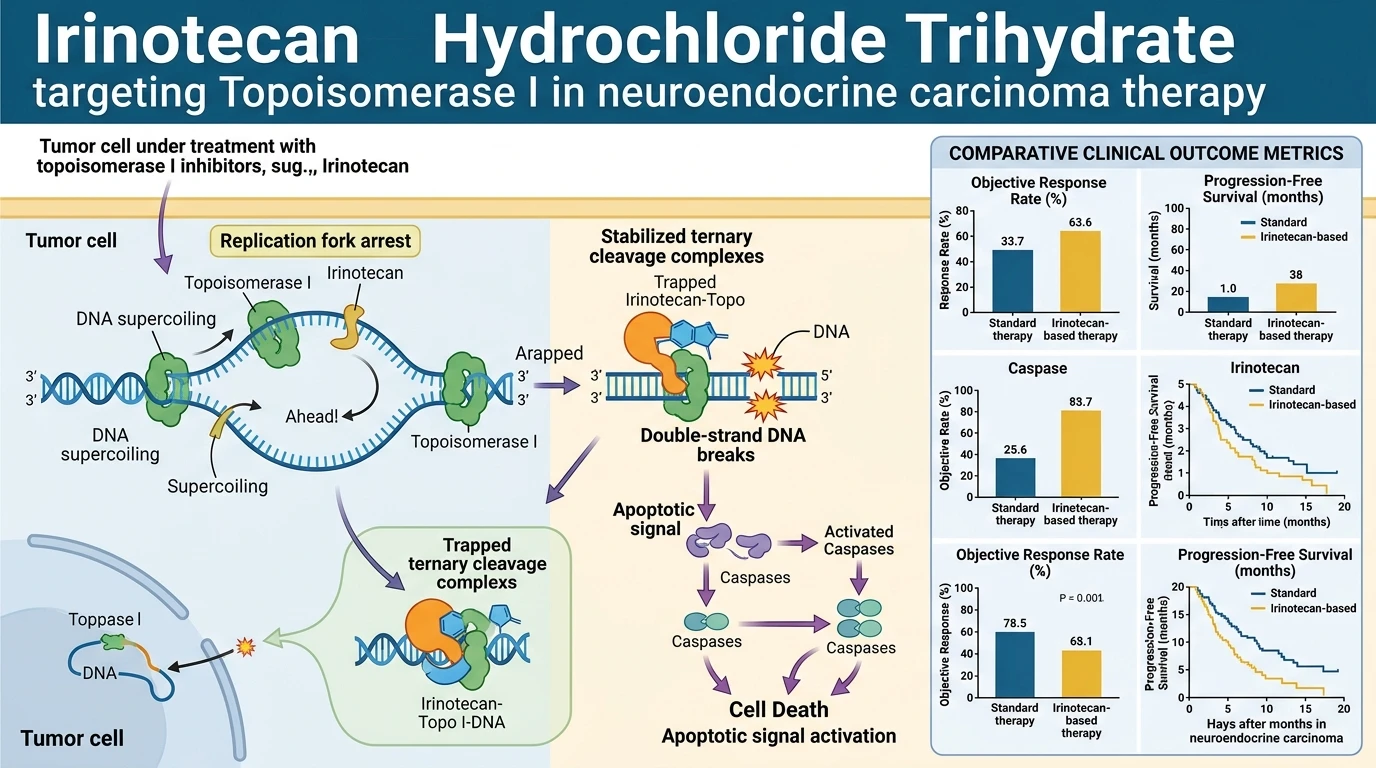
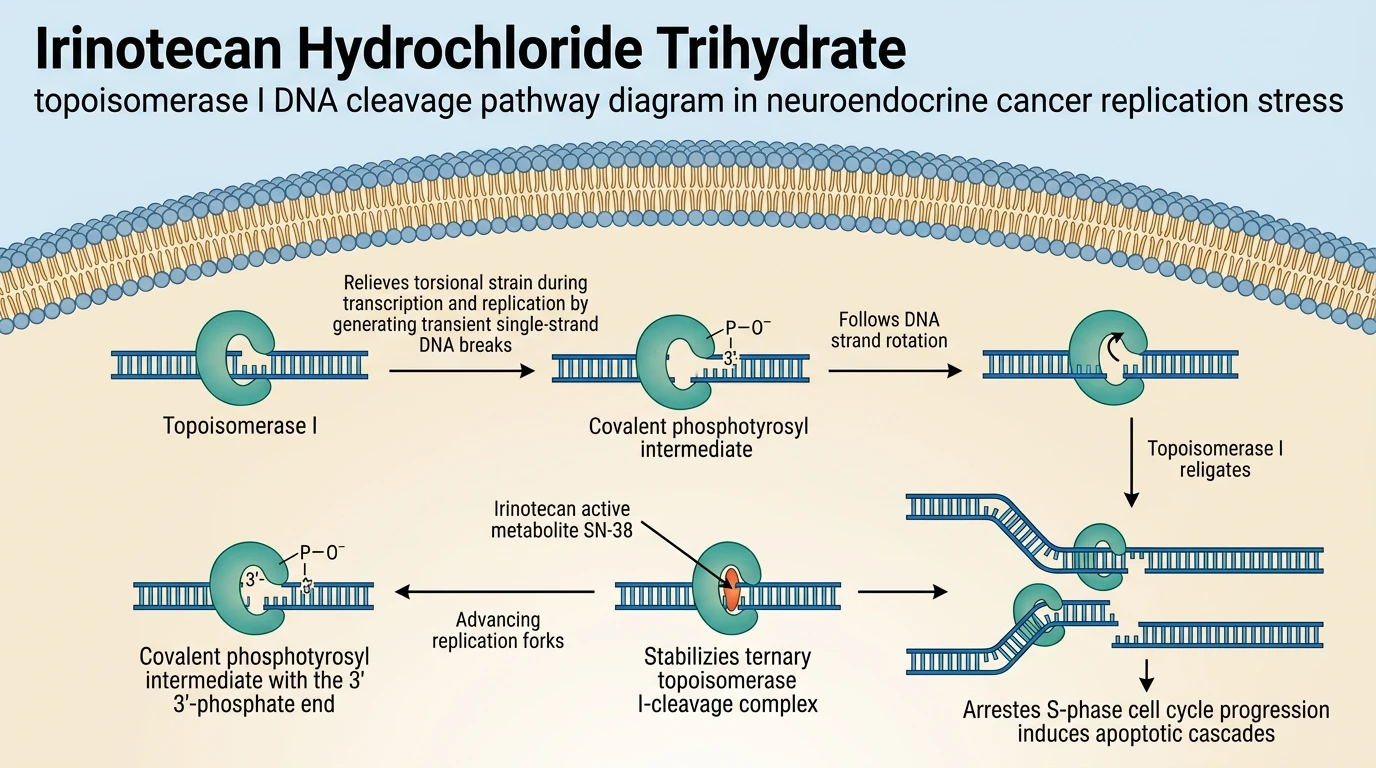
Targeting nuclear enzymes that control DNA supercoiling represents a validated chemotherapeutic strategy in aggressive malignancies. The human topoisomerase I enzyme relaxes positive and negative supercoils generated during transcription and DNA replication. It accomplishes this relaxation through a controlled single-strand nicking mechanism. The enzymatic process forms a transient covalent 3'-phosphotyrosyl linkage with the DNA backbone. Following physical strand rotation around the intact strand, topoisomerase I religates the phosphodiester bond. Irinotecan Hydrochloride Trihydrate functions as a prodrug requiring enzymatic cleavage by hepatic and tissue carboxylesterases. This hydrolysis yields the biologically active lipophilic metabolite SN-38. SN-38 binds directly to the topoisomerase I-DNA complex, specifically trapping the enzyme in its covalent intermediate state. The trapped complex impedes the religation step. During active cell division, advancing DNA replication machinery collides with these persistent ternary complexes. Collision converts reversible single-strand breaks into lethal double-strand DNA lesions. Accumulation of unrepairable double-strand breaks triggers the S-phase DNA damage checkpoint, halting cycle progression and driving programed cell death through mitochondrial caspase pathways.
In clinical oncology, evaluating topoisomerase I inhibition requires rigorous comparative trial designs against establish cytotoxic regimens. A multi-center randomized phase 2 clinical trial investigated the efficacy and safety of Irinotecan Hydrochloride Trihydrate in combination with cisplatin (IP) relative to standard etoposide plus cisplatin (EP) as first-line therapy for advanced, poorly differentiated gastroenteropancreatic neuroendocrine carcinoma (GEP-NEC). The study enrolled 66 patients allocated across the two arm combinations. Primary evaluation metrics included objective response rate (ORR), progression-free survival (PFS), overall survival (OS), and severe treatment-emergent adverse event incidence.
Quantitative analysis revealed matching objective efficacy metrics between the investigational and control cohorts. Both the IP and EP treatment arms achieved an identical ORR of 42.4% in evaluable patients. Median progression-free survival recorded 6.4 months in the EP cohort versus 5.8 months in the IP cohort. This difference did not reach statistical significance (P = .81). Similarly, median overall survival measured 11.3 months with EP compared to 10.2 months with IP (P = .37). These clinical metrics confirm that the topoisomerase I inhibitor combination provides equivalent tumor shrinkage and survival outcomes relative to standard topoisomerase II-targeted combinations in this clinical setting.
Safety evaluations identified contrasting toxicity profiles between the two regimens. Patients receiving EP experienced significantly higher rates of severe hematological toxicity. Grade 3 or 4 neutropenia occurred in 45.4% of the EP group compared to only 12.1% in the IP group. Conversely, the IP regimen exhibited a higher frequency of severe nonhematological toxicities, registering 54.5% compared to 18.2% in the EP cohort. Principal nonhematological toxicities in the IP group consisted of manageable gastrointestinal effects, including grade 3 diarrhea and delayed-onset emesis. These findings demonstrate that while overall survival efficacy remains statistically indistinguishable, Irinotecan Hydrochloride Trihydrate combined with cisplatin provides a distinct, non-inferior clinical option with a favorable hematological safety profile.
Comparative Clinical Efficacy and Toxicity Profiling
Copy code to add this image to your page
Irinotecan is converted into SN-38, a potent topoisomerase I inhibitor. SN-38 binds to topoisomerase I-DNA covalent complexes, preventing DNA single-strand religation. Moving replication forks collide with trapped complexes during S-phase, generating double-strand DNA breaks that trigger cell death. In clinical trials for gastroenteropancreatic neuroendocrine carcinoma, irinotecan plus cisplatin achieved an objective response rate of 42.4%, demonstrating non-inferior efficacy to etoposide plus cisplatin while significantly lowering severe neutropenia rates.
Identical Tumor Response Rates in Advanced Neuroendocrine Malignancies
In randomized phase 2 trials evaluating gastroenteropancreatic neuroendocrine carcinoma, therapeutic efficacy hinges on rapid tumor burden reduction. The administration of Irinotecan Hydrochloride Trihydrate in combination with cisplatin demonstrated an objective response rate of 42.4%. This figure matched the standard etoposide plus cisplatin arm precisely. Tumor regression was confirmed via standardized RECIST criteria. Median progression-free survival reached 5.8 months in the irinotecan group versus 6.4 months in the control cohort (P = .81). Overall survival metrics followed a parallel trend; patients survived a median of 10.2 months and 11.3 months, respectively (P = .37). These clinical endpoints indicate that topoisomerase I suppression yields comparable antineoplastic activity to topoisomerase II inhibition in high-grade neuroendocrine tumors.
Divergent Toxicity Profiles Guide Personalized Chemotherapy Selection
Safety monitoring revealed distinct toxicological trajectories between the treatment cohorts. High-grade bone marrow suppression predominated in the etoposide group. Grade 3/4 neutropenia affected 45.4% of etoposide-treated subjects, whereas only 12.1% of patients receiving Irinotecan Hydrochloride Trihydrate experienced equivalent myelosuppression. Neutropenic fever episodes were correspondingly reduced. Conversely, nonhematological adverse events appeared more frequently in the irinotecan cohort, reaching 54.5% compared to 18.2% in the control arm. Cholinergic reactions and delayed gastrointestinal hypermotility represented the primary nonhematological events. These toxicities were managed through standard anti-diarrheal protocols and dosage adjustments. The distinct safety profiles allow clinicians to tailor first-line chemotherapy choices based on individual patient comorbidities.